
The perception of Vietnamese structural steel fabrication as a compliance risk is increasingly at odds with the reality. Here is what the evidence actually shows.

For many Australian engineering and procurement professionals, Vietnamese structural steel fabrication carries an assumption of compliance risk — an assumption rooted in the early days of offshore manufacturing when quality systems were immature, documentation was inconsistent and independent oversight was limited. That assumption is increasingly disconnected from the reality of what leading Vietnamese manufacturers are delivering today, and it is costing Australian projects a significant and accessible cost advantage.

The Perception Gap

The concern is understandable. Stories of non-compliant welding, missing documentation and logistics failures from unmanaged offshore procurement arrangements have circulated in the Australian construction and mining industries for years — and those risks are real when offshore fabrication is approached without the right management framework. But attributing those risks to Vietnamese manufacturing as a category, rather than to unmanaged procurement as a practice, leads to a conclusion that the evidence does not support.

The question worth asking is not whether Vietnamese manufacturing can meet Australian Standards. The question is whether the right Vietnamese manufacturer, supported by the right oversight framework, can do so consistently and at scale. The answer, demonstrably, is yes.

What World Steel Group’s Credentials Actually Mean

World Steel Group is the first company in Asia to achieve the IAS AC472 certification in structural steel — a globally recognised accreditation that reflects the maturity and depth of their quality systems and fabrication capability. They hold certifications including AS[BS1] /NZS 5131:2016, ISO 3834-2:2021, EN 1090 and ISO 9001:2015, and are certified to CC3 — the highest construction category under AS/NZS 5131, reserved for structures where fabrication quality and documentation requirements are most demanding.

These are not project-specific certifications obtained to satisfy a client requirement. They are permanent, facility-wide accreditations that reflect how World Steel Group manufactures every day — the systems, workforce capability and documentation discipline that underpin every project they deliver.

For Australian procurement and engineering professionals, this means access to a manufacturing facility whose compliance credentials are objectively comparable to — and in several respects more comprehensively certified than — many domestic fabricators.

The Role of Australian Oversight

Certification credentials alone do not eliminate procurement risk. What converts manufacturing capability into consistent project certainty is the oversight framework applied around it. Retaining all structural engineering design, shop detailing and compliance coordination within Australia — managed by professionals who understand the local regulatory environment — ensures that the interface between Australian project requirements and Vietnamese manufacturing capability is managed without gaps.

Combined with independent third-party inspection at every critical fabrication stage, this oversight framework means that compliance is not assumed on the basis of certification — it is verified, documented and deliverable.

The Practical Takeaway

The gap between Vietnamese manufacturing capability and Australian Standards compliance is not as wide as its reputation suggests — and for projects working with the right manufacturer and the right management framework, it has effectively closed. The cost advantages are real, the compliance credentials are verifiable and the project certainty is demonstrable.

The more useful question for Australian procurement and engineering teams is not whether Vietnamese manufacturing is good enough — it is whether the supply arrangement around it is managed well enough to realise the full benefit without the risk.

A commercially focused guide for estimating and procurement teams on building the cost and compliance case for offshore structural steel — internally and with your clients.

In a competitive tendering environment, the ability to present a structurally sound, compliant steel supply solution at a demonstrably better cost point is a meaningful commercial advantage. Offshore structural steel procurement, when managed correctly, delivers exactly that. The challenge for estimating and procurement teams is not finding the cost advantage — it is presenting it with the compliance confidence and supply chain credibility that internal decision makers and end clients require before they will accept it.

The Commercial Case Is Straightforward

Offshore structural steel fabrication from a well-managed Vietnamese manufacturer delivers consistent and significant cost advantages over domestic fabrication — advantages that flow directly into your tender pricing and project margins. For warehouse and distribution centre construction, mining infrastructure packages and civil structures where structural steel represents a material proportion of project cost, the difference is commercially significant and entirely defensible when the supply arrangement is properly structured.

The key word is properly. A cost advantage built on an unmanaged offshore supply arrangement carries compliance and programme risks that can quickly erode the margin benefit. The commercial case for offshore steel is strongest when it is accompanied by a compliance and logistics framework that removes those risks entirely.

Building the Internal Case

For estimating and procurement teams presenting offshore steel to internal decision makers, the compliance framework is as important as the price. Business owners, project directors and risk managers will scrutinise the supply arrangement for potential liabilities — and rightly so. The questions they will ask are predictable: Is the steel compliant with Australian Standards? Who is responsible if there is a quality issue? What happens if delivery is delayed?

A well-structured offshore procurement arrangement answers each of these questions directly. CC3 certification under AS/NZS 5131:2016, complete Manufacturing Data Records, independent third-party inspection and a documented logistics management framework provide the evidence base that internal stakeholders need to approve the supply arrangement with confidence.

Presenting the Case to Your Client

End clients — developers, asset owners and principal contractors — have their own compliance obligations and reputational considerations. Presenting an offshore steel supply solution to a client requires the same evidence base as the internal case, communicated with clarity and precision.

The most effective approach is documentation-led. A supplier who can demonstrate CC3 certified fabrication, full QA/QC traceability, independent inspection by ILAC/NATA-recognised organisations and a structured logistics management framework is presenting a compliance case that is objectively stronger than many domestic alternatives — at a lower cost point. That combination is a compelling client proposition.

The Practical Takeaway

The estimating and procurement teams that use offshore structural steel most effectively are those who treat compliance documentation as a commercial asset, not an administrative obligation. A fully evidenced, independently verified offshore supply arrangement does not require you to trade quality for cost — it allows you to present both, with confidence.

Getting Steel to Site on Time — What Effective Offshore Logistics Management Actually Looks Like

For procurement and project engineering teams, logistics reliability is one of the most significant concerns in offshore structural steel procurement. Here is what effective management of that risk actually looks like in practice.

Of all the concerns that procurement and engineering professionals raise about offshore structural steel supply, logistics reliability is consistently at the top. The consequences of late, damaged or incorrectly sequenced delivery to a construction or mining site are immediate and commercially significant — delayed trades, disrupted programmes and reputational damage that is difficult to recover. Understanding what genuinely effective offshore logistics management looks like is therefore central to evaluating whether an offshore supply arrangement is viable for a programme-sensitive project.

The Complexity Is Real — and Manageable

International structural steel logistics involves coordinating fabrication completion schedules with vessel bookings, managing containerisation or breakbulk decisions for oversized elements, navigating port operations across multiple jurisdictions, meeting Australian quarantine requirements and sequencing delivery to align with site erection priorities. Each variable has the potential to affect programme if not managed proactively and with specialist knowledge.

The distinction between well-managed and poorly managed offshore logistics is not luck — it is planning, experience and established relationships across every point in the chain.

Containerisation and Breakbulk

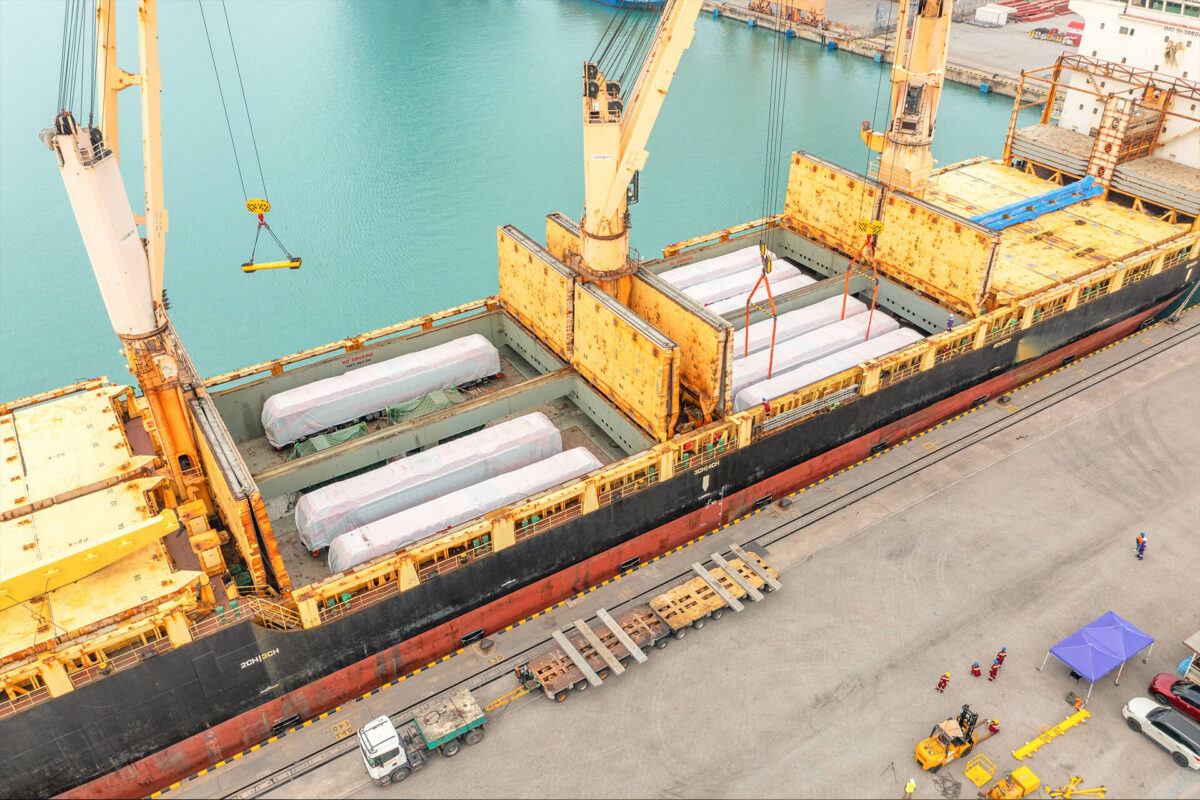
The first logistical decision on any offshore steel project is how the material will be shipped. Standard structural elements are typically containerised — cost-effective and programme-reliable when container management systems are properly structured. Oversized or heavy elements require breakbulk shipping, demanding specialist coordination, sea-fastening design verification and careful port planning at both origin and destination. Getting this decision right at the outset directly affects both cost and programme certainty.

Port Coordination and Quarantine Compliance

For our Australian projects, port coordination spans Cat Lai in Vietnam through to Fremantle, Port Hedland or Singapore transhipment points. Each port has its own operational requirements and scheduling constraints — experienced logistics management means established relationships and operational knowledge at every point in the chain.

Australian biosecurity requirements add a non-negotiable compliance layer. ISPM15 quarantine compliance, rural and tailgate quarantine inspections and accurate materials documentation all demand specialist knowledge of Australian regulatory requirements and their Vietnamese counterparts. Managed incorrectly, quarantine issues can cause significant delays at the point of entry.

Delivery Sequencing

Perhaps the most operationally critical element is delivery sequencing — ensuring steel elements arrive at site in the correct order for the erection programme. Getting sequencing wrong means steel arrives out of order, creating storage problems, double-handling costs and programme delays that are entirely avoidable with proper planning and close coordination between the logistics team, project engineer and site installation team from the outset.

The Practical Takeaway

For procurement teams, the right question to ask of any offshore supplier is not simply whether they can deliver to your site — it is how they manage every step between the fabrication facility and your site, and what happens when something in that chain needs to be adjusted. The answer will tell you whether you are dealing with a genuinely managed supply chain or an arrangement that transfers logistics risk directly to your project.

Why Australian Standards Compliance Cannot Be an Afterthought in Offshore Steel Procurement

A practical guide for procurement and engineering teams on what genuine compliance looks like — and the documentation you should be requiring from every offshore supplier.

For procurement and engineering professionals evaluating offshore structural steel supply, Australian Standards compliance is frequently cited as a capability by suppliers — yet rarely demonstrated with the rigour that serious projects demand. Understanding the gap between claiming compliance and systematically delivering it is one of the most valuable things a procurement or engineering team can do before committing to an offshore supply arrangement.

What Genuine Compliance Actually Looks Like

Genuine compliance is not a certificate on a wall. It is a manufacturing culture, a documented process framework and an independently verified system that operates consistently across every project.

For structural steel fabrication destined for Australian projects, the relevant benchmark is ASBS1 /NZS 5131:2016, which defines fabrication quality, documentation and execution requirements across construction categories CC1 through CC3. CC3 represents the highest classification — reserved for structures where the consequences of non-conformance are most significant. A facility certified to CC3 has demonstrated that its quality systems, workforce capability and documentation processes meet the most stringent requirements of the Australian standard, consistently.

Procurement teams should also look for alignment with AS/NZS 1554 for structural steel welding, ISO 3834-2 for fusion welding quality requirements and EN 1090 for structural steel execution — held permanently by the manufacturing facility, not obtained for a specific project.

The Documentation You Should Be Requiring

Compliance without documentation is unverifiable. Every offshore structural steel procurement arrangement should require the following as non-negotiable project deliverables:

  • Manufacturing Data Records (MDRs) — complete traceability of every steel element from raw material through to fabricated product, including mill certificates, weld records and inspection sign-offs
  • Inspection and Test Plans (ITPs) — defining what will be inspected, by whom, at what fabrication stage and against what standard
  • Weld mapping and welder qualification records — providing full traceability of every weld linked to an independently verified, qualified welder
  • Independent NDT reports — from a recognised inspection organisation operating under ILAC/NATA-recognised frameworks
  • Mill certificates — confirming steel grade, chemical composition and mechanical properties for every element

The Role of Independent Inspection

The most important factor distinguishing managed from unmanaged offshore procurement is independent, third-party inspection at critical fabrication stages. Independent inspection should be structured around hold points and witness points defined in the ITP — ensuring critical fabrication stages cannot proceed without verified sign-off. This is standard practice on well-managed offshore projects and should be a non-negotiable requirement for any Australian-standards procurement arrangement.

The Practical Takeaway

The questions worth asking of any offshore supplier are straightforward: Is your facility certified to AS/NZS 5131 CC3? Do you deliver complete MDRs on every project? Who conducts your NDT inspection and under what accreditation framework? The answers — and the confidence with which they are given — will tell you most of what you need to know.